Monday, October 17, 2011

Thank You

I am speechless.

Holy cow.

I've known all along you guys are incredibly supportive and encouraging and kind and awesome and sweet and fabulous and thoughtful.

But I was still blown away by the response to my post on Friday.

To all of you who congratulated, left comments, linked to, tweeted, facebooked, and/or followed, my sincerest thanks go out to you. You made me giddy and teary a million times over. Being a writer is completely worth it, if only because I get to be in a community with people like you.

You all seriously rock my world in a way words can't even express.


I love you guys!

Friday, October 14, 2011

Quotes and Cookies: Agent Announcement

I have a quote today that's a little dearer to my heart than most quotes. Mostly because I heard it from the quotee just three days ago with my own ears, after working nearly four years to hear it.

"I am offering you representation."

~ Sara Crowe
"Sara, you're the one I really want!"

~Peggy Eddleman

Yeah. When Sara called yesterday to get my answer, I'm pretty sure that's actually what I blurted as soon as I heard her voice. It's just that it's Sara Crowe! She's been my dream agent ever since I heard her speak on panels and I pitched THROUGH THE BOMB'S BREATH to her at a conference last May. I love her! I consider myself a million kinds of crazy fortunate to be able to call her my agent.

I'll spare you my happy dance. And my happy song. I did it for 45 minutes straight last night, and I think it might have scarred my kids for life. Instead, have a happy cookie! It's probably less embarrassing for me, anyway.

http://elenis.com/store/product/smiley/?cat=277

Have a FABULOUS weekend, everyone!

Thursday, October 13, 2011

Dirty Hands Logic

Every year for as long as I can remember, my extended family and I go camping for our family reunion. Two summers ago, I got to be present for this conversation between my five year old niece and my sister, right after breakfast on the second day. You know... that day when you are really feeling the willies that come from living in the wild without showering for two days.

My niece: "Ooo! Can I do your hair?"

My sister: "Oh. Um... no. Sorry-- my hair is really dirty."

My niece: "That's okay! My hands are really dirty!"


Photo credit
Okay, seriously. How can you argue with that kind of logic?

Choosing who to have do your hair is kind of like choosing critique partners. Instead of finding someone whose hands are the same amount dirty as your hair, you've got to find someone whose skill level is close to your skill level to make the partnership really work. To be able to bring each other up to a higher level. If you partner with someone who is well above your skill level, the things they suggest can be overwhelming or even be something you can't pull off. If you partner with someone well below your skill level, you won't benefit as much from critiques.

Ahh. But when you find a critique partner or a critique group whose skills fit well together, magic happens. You rise together. And if you stick together long enough, you'll rise to the level you've been shooting for, and get to find out what lies beyond that.

Finding critique partners that fit with who and where you are pretty much rocks. I highly recommend it.

Wednesday, October 12, 2011

The Way We Are: Pantser, Plotter, or Inbetween?

Pantser, or Plotter. That's the question, right?

Do you plot out every aspect of your book before writing, or do you just start, and see where the muse takes you?

I used to think that everyone was either a plotter or a pantser. You hung out over there with the pants, or over there with the plot (where I swore I hung out). Then I realized that it isn't really a one-or-the-other kind of thing. Plotter or Pantser. Really, it's more like this:

And most everyone is probably somewhere in the middle-- not at one end or the other. I would call myself a plotter. I love figuring out things in my head and on paper and on plots and with images, verses figuring them out as I type. I don't usually have every detail mapped out chapter by chapter, but every time I hear of someone doing that, I get wistful, and think about how I'M TOTALLY DOING THAT IN MY NEXT BOOK.

Then I realized that I'm actually somewhere in the middle. Toward the plotting side, definitely, but I don't actually like to figure out everything ahead of time. I figure out the story arc, character arcs, major plot points, all of the beginning, and a good deal about characters. But there's a lot I KNOW I can't figure out until I work it out in the writing. There is some definite pantsing going on from my corner over here.

So how about you? Where do you stand in the Plotter / Pantser continuum?

Tuesday, October 11, 2011

I've Got a Theory: Director Commentaries

Do you like watching tv and / or movies? Then this theory is for you!

Director / writer commentaries can teach you most everything you need to know about plotting, pacing, and character development.

These guys may write for a different media than us, but they have it going on! The writers and directors of the shows you love really know what they're doing, and if you listen to their commentaries, they will TELL YOU just how they did it.

To entice you to test my theory if you haven't before, I'll share this. Joss Whedon is a genius. (I would've started that sentence with an "I think," but his genius goes well beyond "I think.") I watched a lot of the Buffy the Vampire Slayer and Angel and Firefly episodes while they were on tv, but got them on DVD a couple years later. I wasn't a writer at that point, but I still watched every single commentary on the discs because they were fascinating.

The cool thing? They break down the episode. They talk about every plot decision and why they made it. They talk about character development. They talk about sub-plots. They talked about challenges they faced in the plot and how they overcame them. They talk about the scenes they cut. (Including my favorite cutting advice ever, which I'll share at another time. This is, after all, my theory. It wouldn't be right telling Joss' theory. He needs his own day.)

Joss taught me an incredibly huge amount about writing, and laid the groundwork for me to become a writer. Because of him, a lot of things came by instinct when I started writing.

There are a LOT of really good shows out there, and tons of them have director / writer commentaries. So how do you get to these great commentaries? Good question. I'd say first try googling it to see if there are any online. The more sure bet, though, is to get the show on DVD. So pick one that has been out for more than just this season, get a month subscription to your favorite Netflix-ish provider, and order it on DVD. It's like getting candy, they come with so many special surprises!

Plus, then you can count watching tv as "doing research." You can even bring popcorn! Seriously. Give it a try.

Anyone else a commentary junkie like me? What show have you learned the most from?

Monday, October 10, 2011

Snow, Conferences, and Rooting for a Character

This may still be the view from my front porch:


But at the conference I went to in Park City this weekend, this was the view from the balcony at the cabin we stayed in:


Can you believe all that snow in OCTOBER? The beginning of October, no less? It was crazy. But chilly or not, the conference itself was amazing, as conferences always are. There is nothing like hanging out with a bunch of other people who love writing every bit as much as you do!

One of my favorite parts of the conference was the first night, when John Brown (of Servant of a Dark God fame) did a fabulous presentation right after dinner. (He put up a link to the .pdf of his presentation "Story Lessons from the Hunger Games" on his website, if you want to check it out.)

We all want our characters to be sympathetic, right? Of course the key to making a character sympathetic is to make them likeable, interesting, good, and to give them hardships and danger. It doesn't have to always be physical danger-- danger can be a threat to any kind of happiness.

He said that rooting for a character is more than just having sympathy for a character. They can't just be likeable and interesting and good and have hardships and danger. They have to also be active and have a chance at winning. Sometimes a character only reacts, or waits for others to tell them what to do. We may like the character just fine, but that's not enough to make us really root for them. Our characters have to be proactive. They have to DO things. They have to make choices and act on those choices. Even if they make a wrong choice, even if they lead others into a wrong choice, we root for them if they are actively trying to solve the problem.

My other favorite quote of the night: Your reader doesn't want to know what WILL happen. They want to know and worry about what MIGHT happen.

And he's right! It's the MIGHT happen that gets us every single time.

Friday, October 7, 2011

Quotes and Cookies: Be a Pest

"I think I'd like to be remembered as someone who beat the odds through just plain determination... that I persevered. Because I think that being somewhat of a pest to life, constantly plaguing and pursuing, will bring results."

~Sylvester Stallone
As one of the kings of beating the odds through determination and perseverance, I'd say he's not wrong! Especially when it comes to writing. There is so much to do, so much to learn, so much experience that needs to be gained--- the only way we are going to get there is by being a pest to life. To stay constantly at it. So who's with me? Let's go side with Sly!

Because snow is falling where I'm at and I was still wearing shorts and flip flops just yesterday, making it feel like we MISSED FALL ALTOGETHER, here's the next best thing to fall: Pumpkin Chocolate Chip cookies.

A.k.a. The Best Cookies Ever.

http://zoedawn.wordpress.com/2010/11/17/pumpkin-chocolate-chip-cookies/
Happy Friday! I hope you are all enjoying whatever season it is where you live.

Thursday, October 6, 2011

Rotten eggs: one of the reasons to have a toolbox

***
Tonight I am headed off to the Heart of the West Writer's Conference in Park City, Utah. (Wait... What? Isn't that a romance writers' conference, Peggy? I thought you didn't write kissy scenes! Yes, yes it is. And you're right-- I don't. Just one of the many reasons why I should go.) Anyone else going?
***

When my little brother turned six, my grandma gave him a present. All kinds of excited, he opened it right in front of her to find a gift set of soap and talcum powder, with a cowboys and Indians scene playing around the bottle.

My brother looked at it with a what-the-Sam-Hill-do-you-use-talcum-powder-for? look on his face. I knew the look, because I wore it myself. (Actually, typing this, I'm still wearing that look. What IS talcum powder for?) Judging by the look on my brother's face when he smelled it, it was pretty heavily scented, too. Which was funny, since it was for boys.... Maybe it was anti-boy smell.

To my brother's and my mom's credit, he still managed to be gracious to my grandma, then shoved it into a drawer after she left.

A few months later, we were playing outside with neighbor kids and found an abandoned bird egg on the ground. Some of the boys decided that they better open the egg. You know-- in case there was still a baby bird inside that needed to get out.

There wasn't.

Instead, it contained THE FOULEST SMELL I have  smelled in my entire life. To date. And it spread fast. As everyone pulled their shirts over their noses amid choking and gagging, I saw inspiration light up my brother's face. He ran away, and returned a couple minutes later with the carton of talcum powder in his hand and a look of victory on his face. He had finally figured out what it was for!

Writing is all about solving problems. From ones dealing with sentence structure to plot to characters to setting to organization to pacing to figuring out how to get your characters back out of the tree. One of my favorite writing teachers always said that you need to put lots of things into your writing toolbox, because as a writer you will have to fix LOTS of problems. The more things you have in your writing toolbox, the better equipped you'll be to deal with those problems.

We read things that help us become better writers ALL THE TIME, right? The next time you read something and get that What-the-Sam-Hill-will-I-ever-use-this-for? look on your face, don't dismiss the idea. Graciously place it in your toolbox. Someday you just might run into the problem that it is the perfect fix for.

Wednesday, October 5, 2011

The Way We Are: Your First Novel


You hear all the time "Your first novel is for practice," and "Don't expect to sell your first novel." But the funny thing is, once we decide we want to get published, we fully expect that first novel to do it. There's something inside of us that says But this one is different. The rules don't apply to it / me.

If you ask me, that kind of thinking is actually hugely important. It's what makes us work as hard as we can. And do you know what? A lot of people actually get their first novel published.

So that's my question for the day. What's the status your first novel?


Still writing it?
Haven't started it?
Revising it?
Querying it?
Saving it for posterity?
Shoved it in a drawer to revise sometime later?
Plan on it never seeing the light of day?
Published it?
Burned it?

I want to hear all about it in the comments!

As for me: My first novel had an intended audience of two. I wasn't even thinking writing for real at that point. The writing for real started two months later, and you can bet that publishing it was in the back of my mind the whole time! It was a story I wrote with my kids as the main characters, and I figured that I'd just change them a bit during revisions. I wrote it purely off instinct. Then came my REAL first book. The one with an intended audience of thousands and thousands. :) I jumped off the diving board very deep into the writing world. I took incredible writing classes, went to lots of conferences, read every blog and book on writing I could get my hands on, and worked on writing every spare moment.

The problem was... when I got to the end of the book, I realized I had improved SO MUCH from when I started the book. Revisions were daunting, to say the least. (I kind of felt like this guy here.) Plus, there was this fabulous NEW idea calling my name. Someday I might pilfer ideas from the story, because the concept was great, but I wouldn't revise it. I'd be so much easier to start from scratch.

So what about you?

Tuesday, October 4, 2011

I've Got a Theory: An Untested Name Tag Theory

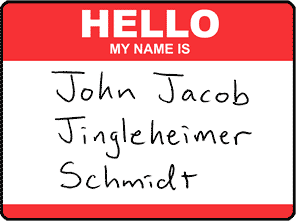
You know when you go to some kind of function where everyone is not very likely to know your name, they have those little "Hello, my name is" stickers?

I cannot seem to grab the marker and write my ACTUAL name. Maybe a crazy version of my name, but not my name itself. And if it's a type of thing where it's of great importance to actually have my real name there and I manage to write it, I can barely manage to wear it.

My theory is that it's a writer thing.

But I've never actually tested my theory, since the only place I usually hang out with authors in hordes is at writing conferences-- the one place where I actually LIKE my name tag to say the correct name. So other than at writing conferences, any of you guys have this same problem? Is it a writer thing, or is it just a me thing?

(Side note: I've always wanted to go to a function with a group of people who were all on board with the changing-of-the-names thing, and have our names be Aie, Bea, Cici, Dede, Effie, Gigi, etc.)

(And did this post remind anyone else of that one Buffy episode the year after they all turned into their costumes? They all worried the same thing would happen again, so they dressed in costumes of much more capable people than they did the last Halloween. Xander dressed as 007. Willow dressed as Joan of Arc because "I figured we had a lot in common, seeing as how I was almost burned at the stake. Plus she has that close relationship with God." Then they asked her boyfriend Oz who he was, and he moved his jacket away so you could see his name tag. It read "God." If you were worried you'd get turned into your costumes, yet still have to fight baddies, I can't say that was a bad choice. :))

OKAY. A couple of tangents later, let's get back to the question. When you see that blank name tag, what are you likely to write in the blank?