Showing posts with label theory tuesday. Show all posts

Tuesday, October 23, 2012

I've Got a Theory: Character Pantsers

Generally speaking, we are each better at either plot, characters, or setting, right? (Click here to see a fun poll on whether plot, setting, or characters came first.) One of those three tends to come more easily to us. It's the thing that feels most real in the first draft. It's the thing that feels most clear to you as you're writing.

And although we're all somewhere in the middle, we each consider ourselves to be either a plotter or a pantser / discovery writer, right?

Here's where my theory comes into play. You ready?

Discovery writers (a.k.a. pantsers) tend to be strongest at writing characters.

I know that a lot of writers get a character (or characters) in mind, then plop them down somewhere in the middle of a situation and see what they'll do. Who wants to plot that? The fun is seeing how the character(s) react to the situation, and then see where it goes from there. It totally works!

On the other hand, you can't really plop a plot down amongst characters in a setting, and see what the plot does. You can't really plop a setting down amongst characters and a plot, and see what the setting does. Obviously both the plot and the setting is colored by everything and colors everything, but it's not the driving force.

So let's go about proving / disproving my theory, shall we? In the comments, tell me what you're strongest at (plot, setting, or character), and whether you're primarily a plotter or a pantser. (Or use whatever phrase you prefer to call it.) I'll start us out.

I'm a Setting / Plotter.

You?

Thursday, May 17, 2012

I've Got a Theory: The Freak Out

I have a theory I've been thinking about a lot the last couple of days, and it goes a little like this:

You decide you want to be published. You set your sites on whatever that means to you.
Yeah.... You THINK you're looking straight at it, but you're really not. You're looking up and over all of the things that come along with it. I'm not talking about all the obstacles along the way. I'm talking about the things that come along with that goal that you don't really think about when you make the goal.

Things like:
  • Sitting at a book signing that no one comes to.
  • Having to write on a deadline.
  • Speaking at conferences.
  • If you write YA or MG or PB, doing school visits.
  • Blogging/facebook/twitter/other social media that makes you step out of your comfort zone.
  • Having your life be not as personal.
  • Dealing with a lot of rejection-- from agents, from publishers, from readers.
  • Having someone take a picture of you at a signing, and having no control over the picture. (So if you had your eyes half-closed, you're in the middle of saying "Right now?" and have your left eyebrow raised, you can't just delete the picture. Chances are good it'll be floating around the Internet somewhere.)
  • That you will have times when you get critiques that your manuscript will be shredded.
  • Finding out that your boss, your mom, your neighbor, that one girl from high school, your spouse/significant other, your kid's school teacher read your book.
  • Getting bad reviews / people being vocal about everything in your book that they hated.
Some affect you more intensely than others, of course, but you were probably thinking of NONE of those things when you first had that spark to be a writer. Then, as you got further into it, you kept coming across these things that are all part and parcel to the whole writing gig! And then it goes a little like this:


A) You freak out.  
Seriously? I have to do that
*hyperventilating* 
I don't know if I can do that!


B) Denial.
No. 
Other people might have to deal with that, but not me. 
After a while, you realize if you really want that goal you've been staring at, this comes hand-in-hand with it.


C) Change or Accept
You either decide to give up on that goal (and change to a goal that won't require you to do the thing you're freaking out about)
OR you choose to accept it. Heck, maybe even EMBRACE it.


For me, my big freak out was school visits. On some of those things, I went through steps A, B, and C in a matter of a minutes. For the school visits, it took a couple of weeks. Panic churned in the pit of my stomach every time I thought about it. I've spent the past three days doing school visits, and I've gotta say, I freaked out way more than I needed to. It has actually been FUN! (Now mind you, I was going classroom to classroom-- not speaking to a full auditorium at a time. I'm sure there'll be more freaking out before I do my first auditorium presentation.)

I thought I had gone through steps A, B, and C on EVERYTHING. Turns out I didn't go there on the whole You-might-be-filmed-doing-a-presentation-and-then-that-presentation-might-find-its-way-online thing. (So make sure that one's not absent on your list of things you need to accept!) It's not that I didn't think it would happen..... it's that I didn't think about it at all. So step A-- the big freak out-- hit pretty hard the last couple of days. I can, with confidence, say that I've made it to step C-- I accept it.

....But that doesn't mean that step A is over. I'll admit-- I'm still freaking out a little bit. But just like everything else, I know eventually that will go away, too.

Which one has been the worst for you so far? Are there some on that list that you intentionally glazed over, because you're not ready to deal with the freak out on them yet?

Tuesday, April 3, 2012

C is for Computer Games

So I've got this theory about computer games. First of all, I think computer game manufacturers are pretty brilliant. They give you such instant payoff! You get points, levels, stars, increased stats.... Virtual pats on the backs. They constantly make you feel like you're doing such a fabulous job. And who doesn't want that?!

But, and here's where the theory comes in, I don't think they have the same effect on everyone. I think everyone falls into pretty much one of these categories. Or, at least, one at a time.

The Gamer-- This person treats gaming like a hobby. They carve out time for it like others might carve out time to watch tv or play tennis. (And the game is typically a first person shooter or an RGP (or even an MMORPG). (And if you don't know what this means, then I'd venture to say that you are NOT a gamer.)) Those virtual pats on the back are just part of the complete package.

The Strategist-- This person uses the playing of games as a way to tire out their left brain, so their right brain can claim exclusivity while writing. The virtual pats on the back? Whatev. They're frosting.

The Time Waster-- This person heads to the game section of facebook when they can't figure out how to dig themselves out of the hole they wrote themselves into, or when they can't figure out what the heck is wrong with the part they are editing or how to fix it. Those virtual pats on the back are the only thing going right. Like water in the desert.

The Ungamer-- This person doesn't need no stinking games! They've either got other hobbies / methods / time wasters, or they are just so completely focused they need nothing else.

What category do you fall into? And if it's one of the first three, what's your poison?

If you fess up, I will, too. I fall into the Time Waster category. And since I've felt a distinct lack of time for a while now, I've stepped solidly into Ungamer territory. My go-to when I occasionally fall off the Ungamer wagon? Bejeweled. My game I don't call a game because I can't just keep playing? Words With Friends. My games I don't consider time wasting because I only play together with my hubby and kids? Call of Duty 2 & Warcraft III maps (because there's nothing quite like the classics ;)).


Tuesday, February 21, 2012

I've Got a Theory: Of real life and hand models

When I was in 5th grade, my parents realized I could paint, and signed me up for the only painting class around-- with an instructor who taught landscape painting. I began to look at the world through the eyes of a painter. Sometimes I'd look at a crazy tree or an incredibly strange sunset and think, If I ever painted that, it would look like I messed up. No one would ever believe that actually occurred in real life!

To illustrate my point, I've taken to hand modeling. Only instead of showing how soft my hands are after using a certain dish soap, I posed in the craziest ways possible.


(Clearly, I have led the life of a bona fide HAND MODEL.)

Crazy, right? But as you can see, also TOTALLY REAL. (Different length fingernails and all.) HOWEVER, if I were to sketch any of these poses, even if I got them completely right, you'd think I was a crap artist, right? Because really, it wouldn't look correct at all.

Which brings me to my theory.

Just like some landscapes (or crazy hands) wouldn't be believable in a painting, 
some things that happen in real life wouldn't be believable in a book.

We work REALLY HARD to make things believable in our books, right? We set things up like crazy, foreshadow, and bring out the parts of our characters' personalities that need to be brought out before certain scenes. That way, when we have larger-than-life scenes/issues/conflicts, they feel right. Like the book just wouldn't be perfect without it. We might want it to surprise our reader, but at the same time, we want it to have felt inevitable the whole time.

In real life, everything is set up, foreshadowed, and personalities are completely developed. And some things STILL don't seem believable! So I guess it's not surprising that real-life things a lot of times don't work when we transfer them to a book.

Have you ever tried to add a real-life crazy story in your manuscript (or read one in a novel), and found that it just really didn't work? I'm not talking about the normal, true-to-life things, but the crazy can-you-believe-that-just-happened things. Do you think there can be a place for them if you set it up right?

Tuesday, November 15, 2011

I've Got a Theory: The List

I'll admit: I'm a list-maker. I make lists for everything. Lists cover my desk, my kitchen counters, my fridge. I kind of make them often. In fact, a couple of days ago, my son sat next to me while I had my blog open, and he pointed to that About Me paragraph over there on the right and said, "You should probably change that line that says 'I make lists as often as I eat lunch.' It makes it sound like you eat lunch ALL THE TIME."

But lists are a good thing! Really. I even have a theory about them.

You see, in your brain you have spots to hold a items in a list. The average person has six slots. Really incredible people have ten. A select few have a freakishly large number. (In your main To-Do list. You've got lots of other lists in your brain, too. They look remarkably similar to your main To-Do list.) Your list stuff fills those slots.

But once your list spots are full, if you add another thing anyway, it just flops down on top of the first thing in your list.

And these things are heavy! One spot can definitely NOT hold two things. So it breaks the slot, and the stuff from that list breaks through to the next line... and the next line... and the next line...
Until all the lines are broken, and the list is all free-floating in your brain. That's what causes overwhelmed, stressed-out feelings to surface. (Unless you're one of the few that thinks it looks like confetti, and then your brain thinks, PARTY!)

I know what you're thinking. Sometimes I just have TOO MANY things in my list! Oh, no! What do I do to keep it from breaking apart?! (Or something entirely less dramatic.)

The answer's easy. Transfer the things in your brain list to paper lists, and it thereby frees up brain lists. Your brain's happy. The people around you are happy. All is well with the world.

Oh! But it does remind me of a quote!

“I write down everything I want to remember. That way, instead of spending a lot of time trying to remember what it is I wrote down, I spend the time looking for the paper I wrote it down on.”
~Beryl Pfizer

Just keep telling yourself that all is well with the world, and you'll be alright. But tell me: Are you a list maker?


P.S. If you want to enter the DIVERGENT giveaway and haven't yet, you still have until tomorrow night!

Tuesday, November 8, 2011

I've Got a Theory: The End is Near

Okay, so I have this theory that if you don't expend creative energy, chaos will ensue. (Seriously. Do it. Bad things will happen if you don't. I stand by my theory.)

Well, I also have this sister theory to my use-creative-energy-to-quell-the-maniacal-monster theory that goes a little something like this:

Witnessing OTHER PEOPLE'S creative energy expenditures can increase yours.

Have you ever been in a creative slump, then you looked at an amazing piece of artwork or photography or a creation of some sort or listened to an amazing song, and suddenly you want nothing more than to go create something incredible yourself?

Yes? See?! It totally works!

Even the simplest of creative expenditures in others can fuel you. My husband and I went to the mall to eat at P.F. Changs. When we walked outside the restaurant, we saw two men in their lower twenties, holding signs written on pieces of cardboard. Their backs were to us, so we couldn't read the signs, but they were well enough dressed that I didn't think they were there to ask for our doggie bags (one was dressed hobo-ish, but it was obvious that it was by choice, not by necessity). Plus, not in an area where people tend to hold cardboard signs. So that left what? Religious zealot preaching the end of the world? We had to find out.

We got in our car and drove around to see them. And that's when I giggled. Or... you know... let out a very un-ladylike guffaw-- depending on who you ask. And then I cursed the fact that I don't take my camera with me every where I go. Nope. Not religious zealots. Just a couple of guys expending creative energy for our benefit.

And do you know what? Their creative expenditure fueled my creativity. I wanted it to fuel yours, too, so I've attempted to re-create the scene.


I hope not too much got lost in the translation.

Here's to hoping we all run into random bits of creativeness that fuel our creativeness! (Because that monster that runs lose in your brain when you don't isn't nearly as cute as he looks.)

Tuesday, November 1, 2011

I've Got a Theory: That Spark is Your Super Strength

Okay, so you know how everyone has one method of learning that works better than others?  Seeing, hearing, or touching, right? You may learn best by, say, by seeing, but you can still learn by hearing or touch-- it's just takes a bit more work.

And you know how there's three basic elements to every story-- Plot (including conflict), Characters, and Setting?

Well, I have a theory that sort of combines the two concepts:

Out of the three main story elements, everyone has one area of super strength that they are a natural at.

About about your current work in progress, think back to the very, very beginnings of it when that first spark of an idea came to you. That thing you built the entire story around. Was it a character that inspired the story? A place where the story would happen? An idea for a general concept or a fabulous conflict? When you get a new story idea, that initial spark-- character, setting, or plot-- generally comes in the form of the thing out of those three you are best at.

So... if I'm a natural at writing characters that feel real, does that mean my plot and setting are going to stink?

No. It just means that you are going to have to try harder on your plot and setting than you had to do on characters. That those things probably aren't going to be strong enough in the first draft, and it will take a few rounds of revisions to get them up to the same level as the thing you've got super powers at.

Okay, so a few examples. I would dare say that Stephenie Meyer's and J.K. Rowling's strengths are in characters. Stephenie said that her characters came to her fully-formed (a huge hint that characters are her strength). And in both of those series, wasn't it amazing how real the characters-- even the minor ones-- felt? And I think than Dan Brown's, John Grisham's, and James Patterson's strengths lie in plot. And that pretty much every high fantasy book's strengths are in setting.

So what do you think? Do you have one area of super strength and other areas that you have to work really hard at to get to the same level?

Tuesday, October 25, 2011

Joss Has a Theory: When It Doesn't Work

Thanks so much Bea Sempere and WilyBCool for the Versatile Blogger award!

Okay. I've said it before, and I'll say it again. Joss Whedon is a genius. I learned a great deal from him by listening to his commentaries. Especially because he commentates the episodes HE writes, and the episodes he writes are always fabulous.

Anyway, I learned a theory from him that BLEW ME AWAY.

Aren't they freaking adorable?
It happened on an episode of Angel. The girl in this picture is Amy Acker, and she plays Fred. When Joss caught wind that in real life, Amy had trained as a professional ballet dancer for twelve years, he decided to write an episode around that, where she could actually do ballet. So in the episode, they all went to the ballet, and of course there was an evil curse involved, because this is a show about paranormal stuff, after all. Wesley here, who was secretly in love with Fred, fell asleep mid-ballet and had his own ballet dream. With him and Fred, of course.

Well.... The awesome scene with Fred being an amazing ballet dancer and Wesley wearing tights and being completely awkward never aired.

Why? Because of Joss' theory. Actually, I think he credited a mentor of his, but in my mind, it was ALL JOSS. He said that things were just off. Something wasn't right. The pacing was wrong, the story didn't flow, something didn't jive. He tried and tried to fix it, but no matter what he did, it just wasn't fixing. Then he remembered something his mentor said. His theory, if you will.

If a particular scene (or your book in general) isn't working,
REMOVE YOUR FAVORITE PART.

Years ago when I watched this, I wasn't a writer yet, and I still felt the stab of pain in my heart when he said that. It's the one piece of writing advice that has stuck with me the strongest. Probably because it's one of the most painful pieces of writing advice I've ever received! Removing your FAVORITE part?! Ouch.

Yet at the same time, I knew he was completely right. I knew it from a million other things I had done, most of which had nothing to do with writing. It makes sense. If you have ONE PART that you won't touch, everything else has to bend for it. It can't go in the direction it's supposed to go, because it is all being pulled to that one part that you're clinging to. And if everything is all bent and warped, then more than likely things are not going to turn out well.

So by removing your favorite part, everything is free to go the direction it needs to go. It isn't being held back.

What do you think? Is he right? Have you ever tested this theory yourself? If you did, how big of a band-aid did you need to cover the gaping hole it left?


Tuesday, October 18, 2011

I've Got a Theory: Brain Dudes. Illustrated.

So you know that belief that we only use a portion of our brains? Do you ever wonder why the heck we have brains so large if we don't even use all of them?

I have a theory about that.

Spread out in those unused parts of your brain are miles of corridors. All curvy, of course, because that's just how brains are. And down those corridors are door after door of living quarters for brain dudes. (Don't believe me? Go into those parts of your brain you've never been in before, and you'll see.)


For the most part, the brain dudes live there peacefully. But sometimes they get restless, staring at gray walls and gray matter all day long. Sometimes the monotony gets to them. And, well... Some of them are bad. First the bad ones throw trash in the hallways and before you know it, they're ripping doors off their hinges and banging on the walls. (That's where headaches come from.)

Then there's this one dude. He's extremely charismatic and buff and well.... evil. He riles up all the bad brain dudes and feeds them propaganda for breakfast. He tells them they're in prison! And they shouldn't have to put up with that! They should be able to roam free throughout ALL of the brain, not forced to stay in the unused parts!

And the bad brain dudes are all like "Yeah, we should!"

So the evil leader leads them into battle, and they fight their way into the parts of the brain that you DO use, and THEY ATTACK.
You're all like, "AAAAAAAAAA!!" Because let's face it-- those guys are scary! They've got weapons, angry facial expressions, and a big ole flag they keep waving around like they're trying to spread discouragement and despair throughout your brain with it.

And it works. Those guys really know what they're doing. And they somehow seem to know EXACTLY when to attack. They know when you're most vulnerable.

But do you know what? Those scary dudes aren't the only ones living in those corridors. Miles of them, remember? There are other dudes. Stalwart ones. Brave ones. And they are at the ready anytime you need them. All you have to do is ask.


That is it. You ask, and they show up, flying the banner of Hope and Perseverance. You think the Despair and Discouragement guys are scary? Think of how scary it is to them to see the numberless army backing YOU.

(And when your numberless army shows up, they bang those spears on the ground in unison and rhythmically. To you, it goes in time to your heartbeat, making you feel invincible. (Plus it sounds cool.) To them, it's a deafening battle cry that makes them cower under their skinny little stick arms.)

Sometimes, though, when Despair and Discouragement shows up, it can petrify you. Sometimes it takes a family member, friend, or complete stranger to summon them for you. BUT THE UNBEATABLE ARMY OF HOPE AND PERSEVERANCE ARE THERE, AND THEY WILL COME.

Always.

You know... As long as you don't forget they're there, hanging out in the living quarters of the unused portions of your brain.


P.S. I know that most people will tell you that the we-only-use-part-of-our-brain theory is bunk, but I don't want to hear it because it doesn't support MY theory. And like the sign hanging in my dad's office says, "If the facts don't fit the theory, change the facts."

Tuesday, October 11, 2011

I've Got a Theory: Director Commentaries

Do you like watching tv and / or movies? Then this theory is for you!

Director / writer commentaries can teach you most everything you need to know about plotting, pacing, and character development.

These guys may write for a different media than us, but they have it going on! The writers and directors of the shows you love really know what they're doing, and if you listen to their commentaries, they will TELL YOU just how they did it.

To entice you to test my theory if you haven't before, I'll share this. Joss Whedon is a genius. (I would've started that sentence with an "I think," but his genius goes well beyond "I think.") I watched a lot of the Buffy the Vampire Slayer and Angel and Firefly episodes while they were on tv, but got them on DVD a couple years later. I wasn't a writer at that point, but I still watched every single commentary on the discs because they were fascinating.

The cool thing? They break down the episode. They talk about every plot decision and why they made it. They talk about character development. They talk about sub-plots. They talked about challenges they faced in the plot and how they overcame them. They talk about the scenes they cut. (Including my favorite cutting advice ever, which I'll share at another time. This is, after all, my theory. It wouldn't be right telling Joss' theory. He needs his own day.)

Joss taught me an incredibly huge amount about writing, and laid the groundwork for me to become a writer. Because of him, a lot of things came by instinct when I started writing.

There are a LOT of really good shows out there, and tons of them have director / writer commentaries. So how do you get to these great commentaries? Good question. I'd say first try googling it to see if there are any online. The more sure bet, though, is to get the show on DVD. So pick one that has been out for more than just this season, get a month subscription to your favorite Netflix-ish provider, and order it on DVD. It's like getting candy, they come with so many special surprises!

Plus, then you can count watching tv as "doing research." You can even bring popcorn! Seriously. Give it a try.

Anyone else a commentary junkie like me? What show have you learned the most from?

Tuesday, October 4, 2011

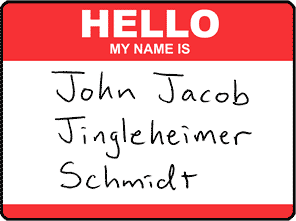
I've Got a Theory: An Untested Name Tag Theory

You know when you go to some kind of function where everyone is not very likely to know your name, they have those little "Hello, my name is" stickers?

I cannot seem to grab the marker and write my ACTUAL name. Maybe a crazy version of my name, but not my name itself. And if it's a type of thing where it's of great importance to actually have my real name there and I manage to write it, I can barely manage to wear it.

My theory is that it's a writer thing.

But I've never actually tested my theory, since the only place I usually hang out with authors in hordes is at writing conferences-- the one place where I actually LIKE my name tag to say the correct name. So other than at writing conferences, any of you guys have this same problem? Is it a writer thing, or is it just a me thing?

(Side note: I've always wanted to go to a function with a group of people who were all on board with the changing-of-the-names thing, and have our names be Aie, Bea, Cici, Dede, Effie, Gigi, etc.)

(And did this post remind anyone else of that one Buffy episode the year after they all turned into their costumes? They all worried the same thing would happen again, so they dressed in costumes of much more capable people than they did the last Halloween. Xander dressed as 007. Willow dressed as Joan of Arc because "I figured we had a lot in common, seeing as how I was almost burned at the stake. Plus she has that close relationship with God." Then they asked her boyfriend Oz who he was, and he moved his jacket away so you could see his name tag. It read "God." If you were worried you'd get turned into your costumes, yet still have to fight baddies, I can't say that was a bad choice. :))

OKAY. A couple of tangents later, let's get back to the question. When you see that blank name tag, what are you likely to write in the blank?

Tuesday, September 27, 2011

I've Got a Theory: What's in a name? LOTS.

My theory is based on another theory. That theory is called the "Theory of Deadly Initials." Maybe you've heard of it. It was published in the Journal of Psychosomatic Research, and said there's a link between the lifespan of human males and their initials. Basically, if your initials are positive (like W.O.W. or A.C.E.), then you'd tend to live 4.8 years longer than people with initials who didn't really spell anything. If your initials were negative (like U.G.H. or D.U.M.), then you'd tend to live 2.8 years less.

You write your initials a LOT over the course of a lifetime. Every time you do, if it's positive, it's kind of a You Are So Cool shot in the arm. If it's negative, it's like a You Stink shot, right?

So here's my theory. You write your last name MUCH MORE than you write your initials! So your last name can have a HUGE impact if it is an actual non-name word, or similar to an actual word.

My maiden name is Wheeler. Is it any coincidence that my dad was a race car driver? That he built hot rods, dune buggies, custom cars and race cars, and fixed wrecked cars as a side job when I was a kid? That my sister manages a car parts store? That three members of my family are in a car show club? That my brother restores classic cars? That nearly every member of my family owns more vehicles than they have licensed drivers? Hmmm....

And that's just one example. The one I'm closest to. I'm sure you can think of several others.

So if W.I.N. makes you be more winning, R.A.D. makes you cooler, F.A.B. makes you be more fabulous, D.U.M. makes you feel dumber, O.A.F. makes you feel clumsy, and B.A.D. makes you feel terrible at everything, then what does having a last name that is also a word mean?

How does it influence what you do, or more importantly, HOW PEOPLE VIEW your possibilities, personality, temperament, stability, and a host of other things? If initials make such a difference, than so can having a last name like Hart. Mason. Parker. Woods. Bright. Cross. Twiggs. Feld. Knight. Price. Law. Butcher. Archer. Cook. Young. Stone. Steele. Farmer. King. Singer. Best.

Does it matter? What about that last time you had to pick a doctor? You stare at a list of doctors your insurance covers, knowing nothing about them except for their names and phone numbers. How do you choose? That's right! Their name! (Unless you're researchy and you don't like to go into things blind. Or if you're choosing based on the ease of memorizing their phone number. Both are also entirely valid methods.)

The truth is, it does make a huge difference.

Which means that the names we choose make a huge difference on people's impressions of the characters we write. Choosing a name that doesn't really have connotations isn't a bad thing-- it's more of a neutral thing. But you can choose a name based on its connotations, good or bad, and that can make an incredible difference in people's perceptions of that character.

Choosing a character's last name is pretty incredible. When else in your life do you get to actually choose a last name? Last names can be hugely powerful. We should wield that power well.

How do you choose characters' names? By their connotations, or just by how cool they sound?

Tuesday, September 20, 2011

I've Got a Theory: The Need for Stories

It's Tuesday, which means I've got a theory! Funny how that always happens on Tuesdays...

So here's my theory:

EVERYONE has a need for stories.


I work at an elementary school, and a particular group of sixth graders from three years ago were especially memorable.

One group of girls, determined to kill off a section of grass by year's end, sat in a circle in the exact same spot each recess and chatted. Every so often, I'd wander near and eavesdrop. I'd catch things like "You are NOT going to believe what he did!" and "Are you serious? That's CRAZY! So what did you do?"

A second group of kids always played a game that seemed equal parts Dungeons & Dragons, and every fantasy book they'd ever read. They would decide what kind of character they were going to play, what special abilities they'd have, what the epic good-versus-evil fight would be, and then they'd act it all out.

One group traipsed to the ends of the playgrounds and fields and back, while the other sat unmoving. They both did the exact same thing, though. They created stories.

At a writers' conference a couple years ago, Tracy Hickman talked about this same thing. About how, when we see something with an incomplete story, we fill in the gaps. And it's true! If we walk into our favorite grocery store and see someone sitting on the sidewalk with their back against the building, face tear-stained, clothes nice but mud-crusted and torn, our minds start forming a story as to what happened.

(Right? Did you start making up what had happened to this person?)(And if you thought of something interesting, I want to hear about it in the comments!)

Tracy Hickman even took it one step further. He asked us to imagine a world where there were no stories. [Pause... pause...] Then he said, "In your head, you just started writing the story of the place with no stories, didn't you?"

BUT.

Think of the story you thought of with the person at the grocery store. And about the world with no stories. Those girls killing the grass weren't talking about the square root of pi. And the D&D kids weren't talking about elves skipping through the forest. So the REAL theory is:

Everyone has a need for DRAMATIC stories.

Some people definitely have a greater need than others. (Writers probably have the greatest need of all!) But we don't want those stories to be things we experience all the time. We want stories outside our range of normal. We want them to be the things we either don't experience often, or the things we'd never experience on our own.

People NEED stories. So how freaking cool is it to be a writer?

Tuesday, September 13, 2011

I've Got a Theory: The glass is half full

As fabulous and awesome as the writing life is, it's not always full of rainbows and lollipops.

Maybe our critique group didn't like our latest chapter... An agent sent a rejection... A reader gave a bad review... A scene just isn't working out... Edits getting you down... Having a bad day of writing...

I have a theory, though, that says that No matter how bad things seem, you can ALWAYS find the good in it.

Allow me to illustrate with a funny story. My then eight year old daughter and I were getting the Christmas tree ready to decorate a couple of Christmases ago. I was stringing the lights, and she was checking each strand to make sure the lights all worked. One set was not as bright as the others, so I set it aside. I hoped not to use it, but as I got closer to the end, it became obvious that I'd have to if I wanted to cover the whole tree. I sighed and picked up the dim set.

My little girl: "It's okay. Using dull lights is better than using no lights at all. Just like having a dead cat is better than having no cat at all."

Me: "WHAT?! I'm pretty sure I'd rather have no cat than have a dead cat."

My daughter: "But you can still pet a dead cat."

No, I wasn't speechless. I don't think you can call gut-injuring laughter "speechless." When I gained my breath and my composure, I praised her for her astonishing ability to, once again, find the good in anything.

In my family, we no longer use the expressions "every cloud has a silver lining" or "glass half-full." We use "A dead cat is better than no cat at all." My daughter asked if she was ever going to live that down. The answer is no.

But do you know what? She was totally right. You can find the good in EVERY SINGLE SITUATION. Even the really crappy ones. Those people that are always happy? I'm convinced it's because they are experts at finding and focusing on the good in any situation. It's not magic. Anyone can do it.

Your critique group didn't like your chapter? Now you know what to change. And it's way better to know now instead of ten revisions later when you really couldn't stand to change something that big.

An agent sent you a rejection? Now you are one agent closer to finding your dream agent.

Got a bad review from a reader? Maybe. But how many GOOD reviews did you get? And any publicity is good publicity, right? And then of course, whatever doesn't kill you will make you stronger. :)

Scene not working out? Then you get to have that awesome scene spending more time living in your head than you would've gotten otherwise.

Edits getting you down? It'll make finishing all the sweeter.

Having a bad day writing? Well, I think we can all agree that...

A bad day writing is better than a day of no writing at all.

Tuesday, September 6, 2011

I've Got a Theory: You can fire your inner editor

Inner editors. We've all got them. They're helpful, I suppose. Without them, revisions might be overwhelming. Some, though, can be decidedly less helpful. When they're too strong, drafting can be overwhelming. The best kind of inner editor leaves you alone most of the time until you are ready for their services.

Well, what if you have a terrible inner editor? One that just really isn't working out for you? I've got a theory about what you can do.

Inner editors can be fired. And you can hire one that better suits you.

It's true! I started out with Miss Stakeless. She was around for my first book. She walked around in my head while I wrote, ruler in hand, ready to rap my knuckles.


She demanded I used correct punctuation.
She demanded I used correct spelling.
She demanded I used correct grammar.
She demanded I didn't use words that end in "ing" or "ly."
She demanded I varied my sentence structure.
She demanded I didn't use the same words too close to one another.

She said if I took it slow and got it right the first time, I'd be happier later. "Slow but steady wins the race," she said WAY too often.

I was afraid of her, so I listened and I did what she said. My knuckles are pansies.

The whole time, though, I had my eyes on this guy:


His name is Doodle, but he prefers to be called Dood. (Heavy on the "oo.") Sure, he's a punk. And sure, he needs to pull up his shorts a bit. And after a while, that surfer lingo might get a little old.

But he's a genius.

And I've heard he'd be quite content to surf while I type, and only get picky about the editing when I was good and ready to edit. Plus, cartoon Inner Editors just seem so much more... fun. So, I called Dood on his cell phone and asked if he wanted the job.

He was in Australia, shredding some serious waves. He said he was unwilling to leave such perfect crests, but more importantly, I wasn't ready for him as an inner editor yet. (Whatever, Dood.)

For someone who seems so one track minded, he can be surprisingly astute. And he did recommend someone else to do the job. I am happy to report that I hired her.

She was an Editing Magician, or E.M., but she liked it when I called her "Auntie Em."

We got along great! I gave her free roam of the brain kitchens, and she baked cookies while I wrote. My brain likes working to the smell of cookies. While I wrote a first draft, she only stopped by to tell me that I used a passive voice, or that I hadn't varied my sentence structure enough every 9 to 11 minutes, instead of constantly like Miss Stakeless did.

I loved her. I loved her cookies. I loved her smiling face. I hope she liked living in my brain. I gave her a room with lots of windows where there was always sunshiny days. There were big, comfy chairs and lots of yarn for knitting. I even placed her in the part of my brain furthest from my imagination, so she could go for an evening stroll and not worry about bad guys or monsters suddenly appearing on the paths through my brain.

Then one day, I got a call. Dood said that I was finally ready to have him as my inner editor! I didn't exactly fire Auntie Em as convince her that someone else needed her services even more than I did. (But I also managed to convince her that I still need the cookies the most, and that my brain kitchens were always open to her. Every once in a while she still stops by to bake a batch.)

So there you go. Proof that you can fire your inner editor and get a new one if the one you've got isn't quite working out for you.

Tuesday, August 30, 2011

I've Got a Theory: Walk-n-Plots

So I have a theory that goes like this:

A Brain can't focus on just one thing unless it knows well where it's going.

Which I realize totally goes against the "One track mind" theory, but hear me out.

Have you ever sat down to write, but hadn't worked through your next scene (or where your plot is going) or what your next blog post is going to be about, and you get a little distracted? You sit and stare at the screen and think, Uhhhh.... I think I'm going to make my MC's bff find a note she had actually written to.... um.... Oh! I need to go into my online banking to see if that check cleared! Okay, back to writing. Hm.... So when she finds the note, she's going to THINK that it was really to her and.... Oh, my gosh! I was supposed to check to see if SIL posted those pictures on facebook! I almost forgot!

It's because your brain can't just do one thing, unless it knows VERY WELL what it's doing. If you aren't sure where you're going with a scene, your brain is working that out but at the same time it's working on other non-what-you're-trying-to-work-on things.

So how do you solve this problem? It's really simple, actually. You give your brain a task to work on that it DOES know very well. One it could do with its eyes closed. The dishes. Making dinner. Mowing the lawn. Folding clothes. Vacuuming. Once its tied up doing those jobs, the rest of your brain is free to focus on what you're trying to work out. It stops going all ADD on you.

For me, my favorite way is what I like to call a Walk-n-Plot. I head to a canal near my house that has a dirt pathway to the side of it. Really similar to this picture, actually.


The canal road is perfect because there aren't many people on it. Not many people to see that I talk to myself A LOT when I Walk-n-Plot. This is also where the cell phone voice recorder comes in handy. As I come up with one plot puzzle piece, I can record what I figured out instead of trying to hold it in memory while I work on the next puzzle pieces. Plus, whenever a runner comes by, they can just assume that I'm talking on the phone, instead of to myself.

So, once you've Walked-n-Plotted, cleaned house, showered, or whatever else got your brain working on something else so you could figure things out, then your brain is in that category of knowing exactly where it's going. And once you know where you're going, your brain can focus on it entirely.

(Pantsers, I know you may be thinking my theory is bunk at this juncture, but I've pantsed my way through a few things, and I think the theory still holds. When you sit down to write, don't you find yourself getting easily distracted until you get that spark of where to go? Once you get it, the ideas start flowing, and your brain suddenly KNOWS WHERE IT'S GOING. Then the distractions stop.)

What do you do to keep your brain busy enough to let it focus on figuring things out?

Tuesday, August 23, 2011

I've Got a Theory: Brain Storage System -I even illustrated!-

So I have this theory about how our brains hold everything. Since a picture says a thousand words, and I know you don't want to read a several-thousand-word post, I decided to illustrate my point. Literally.

As you are going throughout your day, everything you experience and learn goes right in here:
It's not a huge container-- it fits exactly a day's worth of stuff. If there is anything you learned during the day, or any memories you really want to keep, you've got to pull them out of this bin and stick them into your brain storage system. Because while you are sleeping at night, the night clean-up crew comes along, preparing for the next day, and dumps it all into this:


This is a much larger container. It can fit a LOT of days' worth of memories. So if you forget to put something into your brain storage system that you really wanted to keep, you can go dumpster-diving in here and get it back.

You need to be aware of two things, though. First, your memory of that-blog-post-that-filled-in-the-missing-piece-to-the-scene-you-were-working-on might have gotten the memory of the-one-piece-jumper-suit-you-saw-someone-wearing-and-made-you-fear-they-might-be-coming-back-in-style spilled all over it. Second, all those new memories that get poured into this bin every night fall on top of all the other memories there, pushing everything down a bit. The ones at the very bottom get pushed out that tube, and fall right out of your brain. So you don't want to wait too long to go dumpster diving, or it'll be lost forever.

Okay, so once you pull out a memory you want to keep, you need to store it. Different people have different ways of storing this information. There are shelves lining the entire perimeter of your brain that you can store stuff on. Some people put all their memories into nice, organized boxes, with labels on the front so that when they need to pull out a memory of, say, when is the correct time to use laid, lain, or lay, they can go right to the correct box and pull it out.

When some people have memories they want to save, they sometimes grab the nearest container and stick it in there. Most of the time, that's perfectly fine, too. Other people don't use containers at all-- they just stick the memories all willy-nilly on the shelves themselves, and their brains resemble a hoarder's house. AVOID THIS AT ALL COSTS. Seriously, people. Using a plastic grocery bag is a million times better than just shoving the memories on the shelf.

Of course some memory containers are better than others. Take the laundry basket, for instance.


Sure, you can put lots of stuff in it, but when you're not looking, memories can slip out through those giant holes and fall right to the floor. Even the nice, neat, cardboard boxes can be an issue.


If you're not paying much attention to what's in that box, it can get water damaged. Or nibbled on by mice. Or torn. And memories can fall right out. (Yeah, I'm looking at you, rotted Trigonometry box.)

And if you don't notice that the memories have fallen out, the night crew sweeps them up and dumps them right back into here.


So make sure you label your boxes well, and keep checking on those ones that are really important! Otherwise you have to rely on being perceptive enough to know when to go dumpster diving, or those things you learned / experienced / loved might just be pushed out.